Machinery Regulation: when a retrofit makes you the manufacturer, and when it doesn’t
8 min read
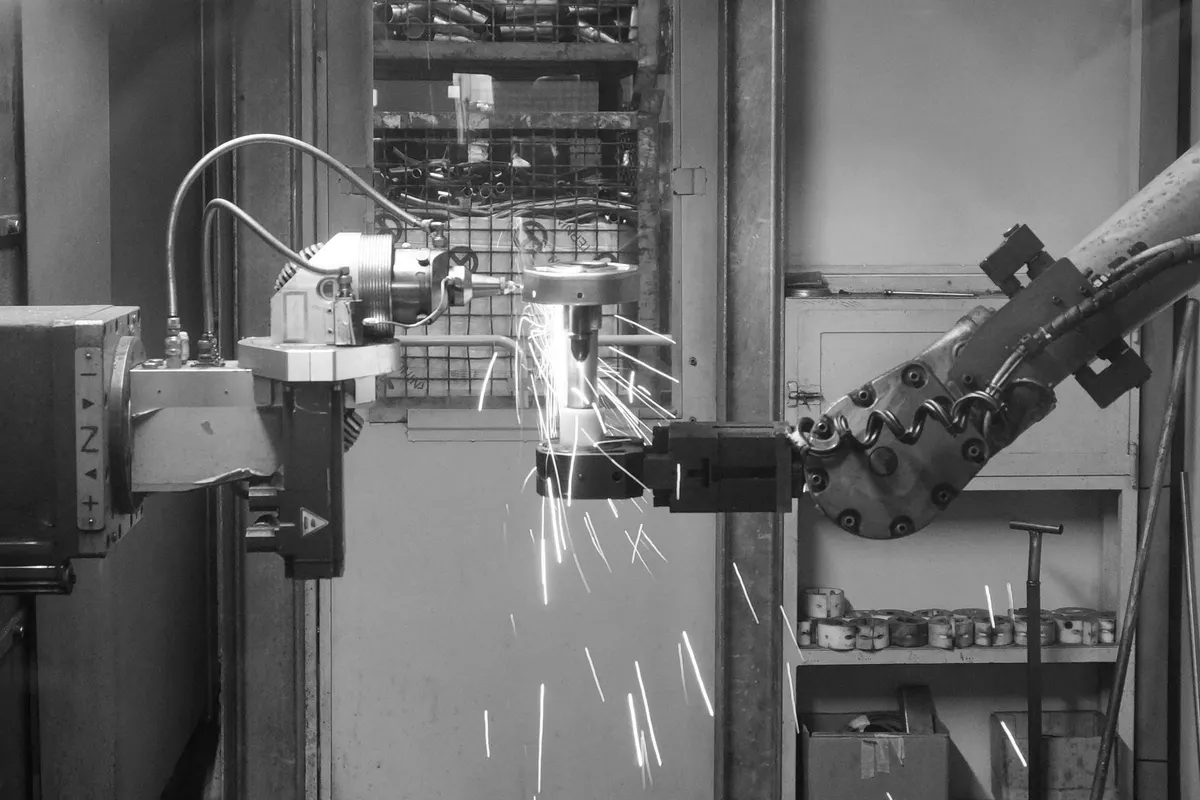
Thousands of Italian companies work every year on a line that is already installed: they swap out a PLC, add a photoelectric safety barrier, rewrite the software that runs a robotic cell. From 20 January 2027 — not the 14th, as the uncorrected CELEX text of Regulation (EU) 2023/1230 still states, corrected by a corrigendum of 4 July 2023 that shifts fourteen dates in the text — some of these interventions trigger an effect that few commentaries bring fully into focus: whoever carries them out becomes the manufacturer of the machine they bought, subject to the obligations the rule reserves for whoever builds it from scratch. But not every intervention is enough to trigger the effect. The definition the Regulation sets is narrow, and rests on two conditions that must be read together, not one at a time — the point that current commentary, almost without exception, misses.
Two conditions, not one
Article 3(16) of Regulation (EU) 2023/1230 defines “substantial modification” as follows: “a modification of machinery or a related product, by physical or digital means after that machinery or related product has been placed on the market or put into service, which is not foreseen or planned by the manufacturer, and which affects the safety of that machinery or related product, by creating a new hazard, or by increasing an existing risk, which requires” — and here the text forks: (a) “the addition of guards or protective devices to that machinery or related product the processing of which necessitates the modification of the existing safety control system”, or (b) “the adoption of additional protective measures to ensure the stability or mechanical strength of that machinery or related product”.
The two parts add up, they are not a choice: the general condition is required — a physical or digital modification, not foreseen or planned by the manufacturer, that creates a new hazard or increases an existing risk — and, on top of that, the modification must require one of the two specific measures listed. An intervention that satisfies only the first part, without touching either guards and protective devices or stability and mechanical strength, falls outside the definition, however unforeseen it was by the original manufacturer. Replacing a PLC with a newer model, keeping the existing safety logic intact and without touching guards or protective devices, meets neither point (a) nor point (b). Installing a new photoelectric safety barrier that requires reprogramming the existing safety control system so that it talks to the machine’s stop function falls under point (a) instead: if that barrier answers a hazard the original manufacturer had not foreseen, the modification is substantial. A software update to a robotic cell that widens its range of motion, if it increases an existing risk and requires additional measures for the stability of the assembly, can fall under point (b); if that software introduces self-evolving behaviour, the framework already covered for AI within the Annex III requirements applies on top.
Repair and maintenance stay outside
Recital 26 — not binding, but part of the text published in the EU Official Journal, not of the enacting terms — states the legislature’s intent: “repair and maintenance operations which do not affect the machinery or related product’s compliance with the relevant essential health and safety requirements should not be considered to be substantial modifications”. Replacing a worn part with an equivalent one, or carrying out the routine maintenance the manual calls for, triggers nothing: it does not affect compliance with the Annex III requirements, even when it was not planned weeks in advance.
Becoming a manufacturer: Article 18
Whoever meets both conditions changes status. Article 18 provides that “a natural or legal person that carries out a substantial modification of machinery or a related product shall be considered to be a manufacturer for the purposes of this Regulation and shall be subject to the obligations of the manufacturer set out in Article 10” for the machinery or product concerned — or, if the modification affects the safety of only one machine that is part of an assembly of machinery, for that affected machine alone, “as demonstrated in the risk assessment”. The same article requires applying “the relevant conformity assessment procedure as provided in Article 25 (2), (3) and (4)” — not a self-certification, but the same route — EU type-examination, full quality assurance or unit verification, depending on the category — that a first-time manufacturer follows before placing a new machine on the market.
There is an explicit exception, worth quoting in full: “A non-professional user who carries out a substantial modification to his or her machinery or related product, for his or her own use, shall not be considered to be a manufacturer for the purposes of this Regulation and shall not be subject to the obligations on the manufacturer set out in Article 10”. It is a narrow door — own use, non-professional user — that does not cover a company modifying its own production line to keep producing.
The obligations that come with the status
Article 10 does not name “risk assessment” as a standalone item, but it imposes it indirectly: paragraph 1 requires that the machinery “has been designed and constructed in accordance with the essential health and safety requirements set out in Annex III”, and point 1 of that Annex’s General principles requires the manufacturer to ensure that “a risk assessment is carried out”. Paragraph 2 requires the Annex IV, Part A technical documentation and the conformity assessment procedure, followed — where conformity is demonstrated — by the EU declaration of conformity and the CE marking. Paragraph 3 sets the retention of technical documentation and declaration at at least ten years. Paragraph 7 requires the instructions for use under Annex III, point 1.7.4 — the minimum content of the manual. Whoever substantially modifies a machine bought from someone else inherits, in short, the entire documentation package of whoever designed it from scratch: not one more formality, an entire technical file to build from nothing for a machine they did not design.
The Italian cross-reference left behind
Legislative Decree no. 81/2008, Article 71(5), looks at the same boundary from the employer’s side: «Le modifiche apportate alle macchine quali definite all’articolo 1, comma 2, del decreto del Presidente della Repubblica 24 luglio 1996, n. 459, per migliorarne le condizioni di sicurezza […] non configurano immissione sul mercato […] sempre che non comportino modifiche delle modalità di utilizzo e delle prestazioni previste dal costruttore» — modifications made to machinery, as defined in Article 1(2) of Decree of the President of the Republic no. 459 of 24 July 1996, to improve its safety conditions […] do not amount to placing on the market […] provided that they do not change the intended use or performance set by the manufacturer. The cross-reference points to a decree that Normattiva flags as repealed by Legislative Decree no. 17 of 27 January 2010 — the text that transposed the Machinery Directive 2006/42/EC into Italian law. Paragraph 5 has not been rewritten to update that reference. What a cross-reference to a repealed source amounts to in practice is a question for legal counsel, not for a note like this one.
What to put in writing before a retrofit
Three things, before ordering the new PLC or the new barrier, should be fixed in writing and not decided verbally on the shop floor. Who assesses whether the modification crosses the threshold in Article 3(16) — normally the in-house engineering office, not the supplier of the new component, who has a direct interest in answering no. What document records that assessment — a dated, signed technical note, not an email exchange, because that is what a market surveillance authority will ask for if the modified machine causes an injury. And who signs the conclusion, taking responsibility under their own name: the same person who, if the conclusion is “yes, it is substantial”, becomes the manufacturer under Article 18.
Checking whether a retrofit crosses that threshold is, on its own, already a control that can run machine by machine before an inspection asks for it. Extended to a fleet with years of layered interventions, the same control becomes the inventory a company uses to decide where to act first: which machine is covered by a proper technical file, which has accumulated modifications never assessed, which is most exposed if an inspector calls tomorrow.
See how we check a technical file · Talk to an engineer
Sources
- Regulation (EU) 2023/1230, Articles 3, 10 and 18 — consolidated text as at 27 July 2026 (EUR-Lex)
- Regulation (EU) 2023/1230 — text as published in the Official Journal, with recitals (EUR-Lex)
- Corrigendum to Regulation (EU) 2023/1230, OJ L 169, 4 July 2023, p. 35 (EUR-Lex)
- Legislative Decree no. 81 of 9 April 2008, Article 71 — text in force (Normattiva, Italian)
- Decree of the President of the Republic no. 459 of 24 July 1996 — repealed by Legislative Decree no. 17 of 27 January 2010 (Normattiva, Italian)