Ursa Major goes to Nasdaq: the contract is filed, the projections are not
8 min read
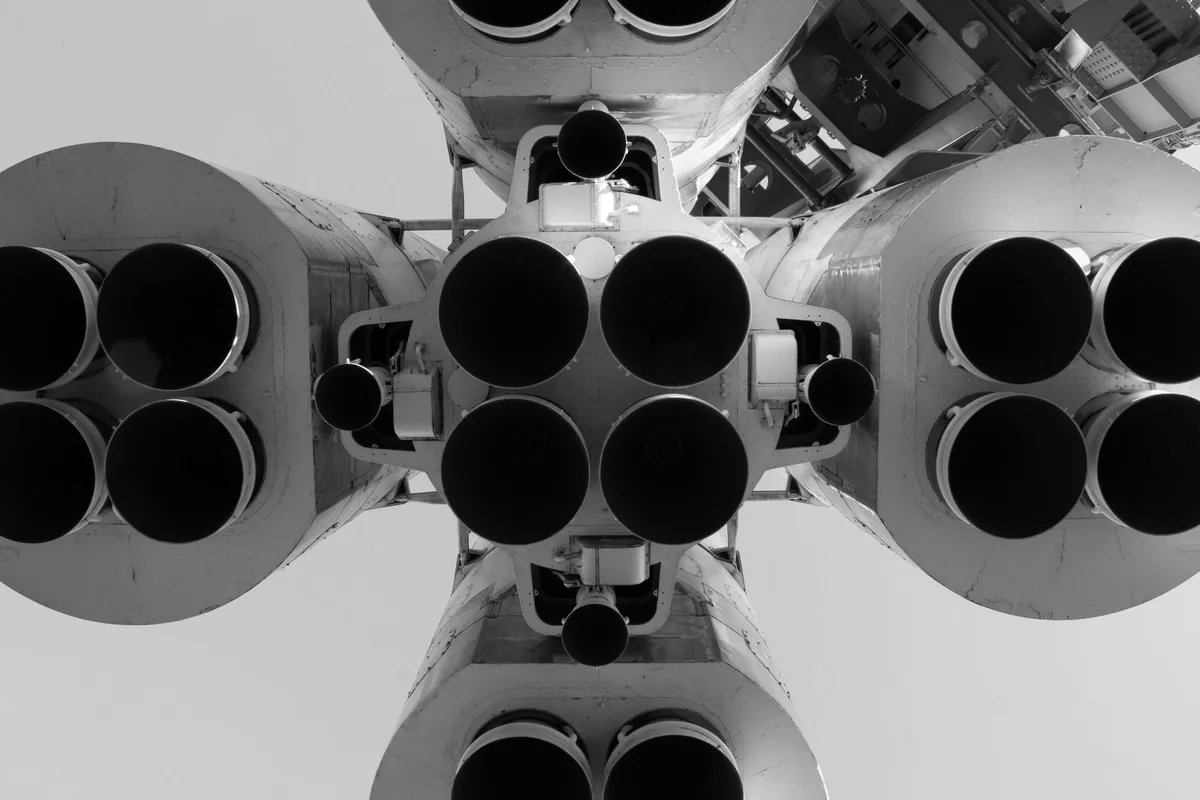
The same filing that makes a real contract public can, a few lines down, transmit a valuation nobody must defend with the same legal responsibility. On 25 August 2026 Ursa Major Technologies — rocket engines, hypersonics, solid propellants — announced it would go public on the Nasdaq through a SPAC merger. The document that formalizes it, a single Form 8-K, holds side by side a contract filed under full liability and a $2.3 billion valuation furnished without that liability — and should hold a third exhibit that is not there.
The contract on file, and the clause that comes with it
The Form 8-K filed on 25 August 2026 (accession 0001213900-26-093229) by Bleichroeder Acquisition Corp. III (Nasdaq: BCCQU) — the SPAC the document itself calls “Mach X” — discloses under Item 1.01 the signing, on 24 August 2026, of a Business Combination Agreement with Ursa Major Technologies, Inc., “a Delaware corporation.” The agreement is attached as Exhibit 2.1, 712,011 bytes: filed, under Section 18 liability.
Item 7.01 — Regulation FD Disclosure houses the press release (Exhibit 99.1) and the investor presentation (Exhibit 99.2), and closes with the sentence this article turns on, verbatim: “The foregoing (including Exhibits 99.1, 99.2 and 99.3) is being furnished pursuant to Item 7.01 and will not be deemed to be filed for purposes of Section 18 of the Securities Exchange Act of 1934 […], or otherwise be subject to the liabilities of that section […].” Furnished, under Item 7.01, does not count as filed: whoever writes it does not answer for it the way whoever signs a contract does. We are not the ones saying so: the document says so about itself.
The exhibit that is missing
The same Item 7.01 also discloses that it is furnishing a third exhibit, verbatim: “Furnished as Exhibit 99.3 hereto and incorporated into this Item 7.01 by reference is certain projected financial information, dated August 2026, that Ursa Major prepared in connection with Mach X’s consideration of the Business Combination and certain investors’ assessment of a potential investment in Ursa Major.” — the point-by-point projections that were supposed to justify the valuation.
It is not in the filing. We checked this three ways: the exhibit list inside Item 9.01 runs 2.1, 3.1, 4.1, 10.1-10.7, 99.1, 99.2 and 104 — no 99.3; the predictable address, ea030301301ex99-3.htm, returns HTTP 404, while the twin addresses for 99.1 and 99.2 both return 200; across all five Form 425s filed on 25 and 26 August, “99.3” never appears. We do not claim it was concealed, nor do we rule out a later amendment: as of this check, it is missing.
The money: $350 million announced, $150 million binding
The press release — Exhibit 99.1, furnished, not filed — opens with the figures that made headlines, verbatim: “The transaction reflects a pre-money equity valuation of approximately $1.6 billion and a post-transaction equity valuation of approximately $2.3 billion. […] The transaction is supported by at least $350 million of PIPE commitments, of which approximately $110 million will be funded at signing […].” Ursa Major, it adds, could also retain up to $345 million in additional proceeds “depending on redemptions.”
The filed contract says something else. Item 1.01 conditions closing on a “Minimum Cash Condition”: the sum of the cash releasable from Mach X’s trust after shareholder redemptions, plus gross PIPE proceeds, minus underwriting fees and transaction costs, must equal or exceed $150,000,000 — not $350 million, less than half, and net. The clause that follows, verbatim: “The Minimum Cash Condition may be waived, in whole or in part, by Ursa Major in its sole discretion.” — the company can lower even that floor on its own. The same figure, verbatim “at least $350M in committed capital,” reappears on 26 August in a Form 425 “Customer/Vendor Communication” to Ursa Major’s suppliers, not just its investors.
Who Ursa Major is, and the $43.5 million in the federal register
Ursa Major Technologies was founded in 2015 in Berthoud, Colorado — the same address, 19750 County Road 7, heads the 25 August press release, which calls it “an aerospace and defense company building hypersonics, solid rocket motors and space mobility systems” and names “the HAVOC Missile System” among its production capabilities. In the same risk factors, Anduril appears as a competitor, not a partner: the same company whose investment vehicles we have already found signed by others.
That same valuation rests on an assumption stated in the same risk factor, verbatim: “Ursa Major’s revenue projections assume the U.S. missiles and munitions budget will grow at an 88% CAGR from FY25 through FY27; if this growth does not materialize […], Ursa Major’s revenue and prospects would be materially harmed.” The same sentence names the programs it depends on: LCCM, APKWS (Advanced Precision Kill Weapon System, a laser-guidance kit that converts unguided 2.75-inch Hydra rockets) and MK 104.
USASpending, the public register of federal prime awards, returns 14 contracts from the Department of Defense since 2019, totaling $43,535,889.16: the largest, $20 million, for a storable rocket engine for hypersonic applications; the rest, smaller amounts, mostly SBIR — research, not production. A factor of roughly fifty separates the $43.5 million verifiable in the register from the $2.3 billion post-money valuation: the prime register misses subcontracts, classified programs, foreign sales and unexercised framework orders — a limit of the data, not proof the rest does not exist.
The question that matters, for the reader
Nothing here is irregular: no rule requires filing forward-looking projections like these. The point — already measured for Quantinuum and Oracle — is that a headline and a document’s legal responsibility are two different things: here the gap is worth $200 million on the closing threshold, and an 88%-a-year growth assumption propping up a $2.3 billion valuation. It is the same lesson already seen in a memorandum that is not a contract and in a partnership announced without a filing: what matters is not the headline, it is who signs and with what liability. Anyone writing Ursa Major into a tender for defence or the public sector should know which statements are filed and which are merely furnished — the same question we ask about who answers when a supplier never planned an exit strategy: which legal entity a right would be enforced against, and who controls it.
See the service · Talk to an engineer
What we do not know
We do not know if or when Exhibit 99.3 will surface in a later filing. We have not verified on a primary source the full names behind LCCM and MK 104, nor technical details of the HAVOC system beyond the press-release line. We do not know how much of Ursa Major’s production capacity runs through subcontracts or sales not tracked by USASpending, nor the outcome of the HSR antitrust review in Item 1.01. Nor do we know how many SPAC shareholders will seek redemption before closing: that number decides how much cash is left in the trust.
The two axes, applied
Compliance. The register of critical capabilities bought from third parties — here, rocket engines and propellants for hypersonic applications — stops being press releases read once and becomes a control running against the supplier’s contracts and public filings: for each capability, which legal entity supplies it, what is filed under full liability and what is merely furnished, which contractual thresholds are binding and which are waivable at someone else’s discretion — with a dated trail, ready for an inspection, a tender or a board meeting.
Decisioning. The same system holds together contracts, suppliers, public filings and technical documents in a single operating model, on which AI agents execute decisions with a human operator in command — for large enterprises, defence, public administration and healthcare. Always in two modes: on-premises, on autonomous machines requiring no deep integration into the client’s network, or a dedicated cloud with a dedicated VPN and a data centre in Italy, always with shared management: nobody is left alone administering a system that has to trust a valuation furnished by someone else.
From the first session, at no cost, comes the dated list of critical capabilities you buy from third parties — which legal entity owes them, what is filed and what is merely declared, including the boxes left empty: yours to keep even if we do not go on to work together. Talk to one of our engineers.
Sources
- SEC EDGAR — Bleichroeder Acquisition Corp. III, Form 8-K, 25 August 2026 (accession 0001213900-26-093229, Item 1.01/7.01/8.01/9.01)
- SEC EDGAR — filing index page (exhibit list: EX-2.1, 712,011 bytes; no EX-99.3)
- SEC EDGAR — Exhibit 99.1, press release, 25 August 2026
- SEC EDGAR — Exhibit 99.2, investor presentation, August 2026
- SEC EDGAR — the expected address for Exhibit 99.3 (returns HTTP 404 as of this check)
- SEC EDGAR — Form 425 “Customer/Vendor Communication,” 26 August 2026 (accession 0001213900-26-093690)
- SEC EDGAR — filing history of Bleichroeder Acquisition Corp. III (CIK 0002128045)
- USASpending.gov — Award Search API, results for “Ursa Major Technologies” at the Department of Defense
- Ursa Major Technologies — “About” page (founded 2015, Berthoud headquarters)
- NAVAIR — Advanced Precision Kill Weapon System (APKWS), official product page